Complete home golf simulator setups ranked at every budget, from $1,500 garage builds to $6,000+ dedicated rooms. Here's exactly what you need, what to skip, and which launch monitors hold up for sim play based on published specs and real owner data.
A home golf simulator isn't a single product. It's a system. Every setup requires five components working together. The good news: you can mix and match at every budget level. Here's what each piece does and what to spend.
1. Launch Monitor: The brain of your simulator. It tracks ball speed, spin, launch angle, and more, then feeds that data to your sim software to calculate ball flight. This is where accuracy matters most. Budget: $600–$3,000+.
2. Simulator Software: The virtual golf course. Software like E6 Connect, TGC 2019, or Garmin Home Tee Hero takes your launch monitor data and renders realistic ball flight on real courses. Some come bundled free; others are $100–$300+ or subscription-based.
3. Impact Screen + Enclosure, Where you hit into. A high-quality impact screen absorbs ball strikes without tearing, and the enclosure contains errant shots. Budget: $200–$1,500 for a complete enclosure with screen.
4. Hitting Mat: What you stand and swing on. A good mat protects your joints and gives a realistic turf feel. Don't cheap out here: bad mats cause wrist and elbow injuries. Budget: $100–$600.
5. Projector or TV: Your display. A short-throw projector creates a theater-sized image on your impact screen, but its throw ratio has to match your image width and mounting distance. A large TV (55–65") works too but sits to the side. You can also skip the projector entirely and run a net-only simulator setup using your laptop or tablet as the display.
Best Launch Monitors for Simulators
Not every launch monitor works well for simulator use. Sim play demands low latency (instant shot feedback), accurate spin data (so the ball curves realistically on screen), and broad software compatibility. The five picks below are ranked based on sim-specific performance (drawing on published specs, software compatibility documentation, and community data) not just raw accuracy figures.
A proven simulator option only while discounted stock remains.
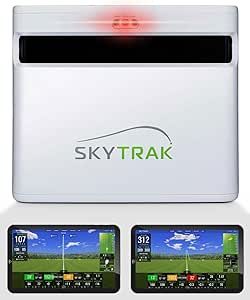
Current status: The SkyTrak+ has been discontinued and replaced by the SkyTrak ST MAX. That changes the recommendation. SkyTrak+ is attractive only when remaining stock is meaningfully cheaper than the current model.
Its reason to stay on this list is software support and familiarity. It works with established simulator platforms including E6 Connect, TGC 2019, and WGT, and it directly measures spin for realistic curves and stopping behavior. Shot delay varies with the computer, network, software, and display chain, so we would not buy any launch monitor based on a blanket latency claim.
If the price gap is small, buy the current ST MAX. If the closeout discount is substantial and SkyTrak+ supports the software you plan to use, the older model remains a defensible value buy.
Technology
Doppler + Camera
Product Status
Discontinued
Successor
SkyTrak ST MAX
Software
E6, TGC, WGT, more
Spin Data
Measured
Reference Price
check current price
Pros
Broad simulator-software support
Measured spin data for realistic ball flight
Long product history and active user community
Closeout pricing can beat the successor
Cons
Discontinued: check stock availability
Requires Play & Improve plan ($99/yr) for full sim features
Real spin, E6 Connect included, sim subscription ~$199.99/yr after year one.
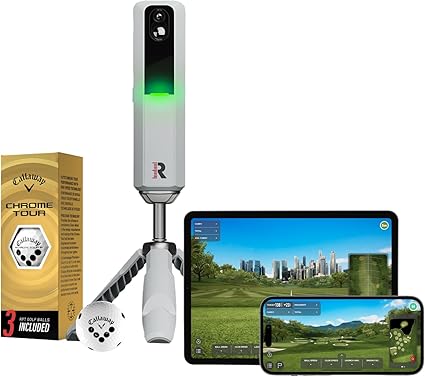
The Rapsodo MLM2Pro punches well above its price class for simulator use. At $599.98†, it includes a free E6 Connect subscription: the same software that costs $300/year with other units. That means five premium courses and full sim play out of the box. After the first year, the E6 subscription runs approximately $199.99/year. The radar + camera system delivers real spin data, not estimates, so on-screen ball flight behaves like your actual shots.
It requires a tripod and takes a couple of minutes to set up each session, but for a dedicated home sim where the tripod stays in place, that's largely irrelevant. The value proposition remains strong: real spin data plus included sim software at this price point is tough to beat.
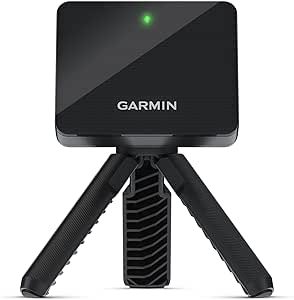
The Garmin R10 is the cheapest path to a functional home golf simulator. Garmin's Home Tee Hero feature gives you basic sim play (42,000+ courses) through the Garmin Golf app for $10/month. It's not the same visual fidelity as E6 Connect or TGC, but it works, and the total cost of entry is dramatically lower than any other sim setup.
The R10 also connects to E6 Connect and other third-party sim software if you want to upgrade later. Spin data is estimated (not directly measured), which means on-screen ball flight isn't quite as realistic as the SkyTrak+ or MLM2Pro, but for most recreational golfers building their first sim, it's more than good enough.
27 metrics and included E6 content, while closeout stock remains.
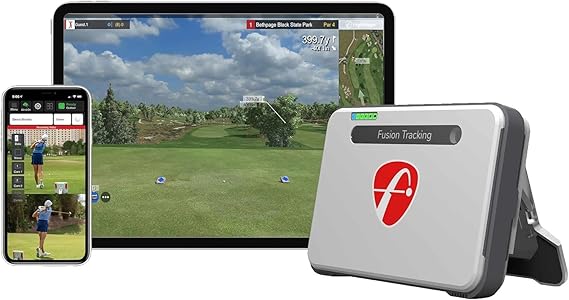
Note: The FlightScope Mevo+ has been discontinued. Remaining retail stock may still be available, so verify availability before purchasing.
The FlightScope Mevo+ reports 27 data metrics and includes E6 Connect content. For data-oriented golfers who want to analyze shots in detail, that remains a compelling package. Club path, face angle, angle of attack, dynamic loft, spin loft, and more feed into simulator ball flight through FlightScope's Fusion Tracking system.
At its current closeout price, the choice versus SkyTrak+ comes down to software and room depth. SkyTrak+ supports a broader selection of established sim platforms and sits beside the ball, while Mevo+ provides more metrics but needs radar space behind the ball.
Foresight photometric platform. Subscription required for full sim.
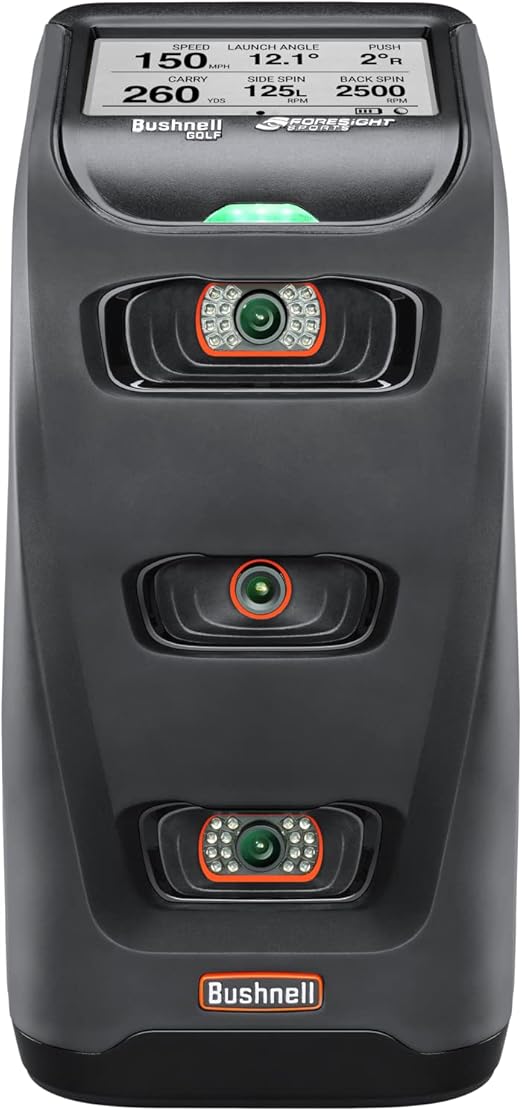
The Bushnell Launch Pro uses the same Foresight Sports photometric camera technology found in commercial club-fitting bays. The Circle B edition is priced at around $2,969.17†: significantly higher than older listings that circulated online. In raw accuracy for spin axis and launch angle, it competes with units costing far more, drawing on Foresight's established photometric platform.
Full simulator functionality (FSX Play + E6 Connect access) requires a subscription of approximately $500/year. If photometric accuracy is your top priority and you're comfortable with the ongoing cost, the Launch Pro is a compelling choice. At this hardware price, it competes directly with the SkyTrak+ and the Full Swing KIT: compare total cost of ownership over 3 years before deciding.
The Full Swing KIT combines radar and camera tracking in one unit, delivering both ball and club data with the accuracy that made Full Swing the simulator brand of choice for Tiger Woods and Jordan Spieth. At around check current price it's a significant investment, but it includes broad sim software compatibility, no required subscription, and the kind of data quality that commercial sim bays charge $60/hour for. If your budget extends into the $5,000 range and you want the best possible sim experience short of a TrackMan, the KIT deserves serious consideration. Read the full review.
The Uneekor Eye MINI is a camera-based overhead unit designed specifically for home simulator bays. It mounts to the ceiling above the hitting area, captures ball and club data at impact, and feeds it to multiple sim platforms including E6 Connect and TGC 2019. The overhead placement means zero floor clutter and no alignment fuss between sessions. At around $2,999.00† with no required subscription, it's an excellent choice for golfers building a dedicated sim room who want clean installation and premium accuracy. Read the full review.
Simulator Software Compared
Software
Courses
Graphics
Cost
Best For
E6 Connect Most Popular
100+
High
$300/yr or included
Best all-round sim experience
TGC 2019 Most Courses
170,000+
Medium-High
$895 one-time
Course variety (user-created)
WGT by TopGolf Free Option
15+
Medium
Free (in-app purchases)
Casual play, free entry
Home Tee Hero Garmin Only
42,000+
Basic
$10/mo
Budget Garmin R10 sims
For a deeper look at every platform (including GSPro, Awesome Golf, and Creative Golf 3D) see our full simulator software guide.
Budget Breakdown: What a Full Setup Costs
Here's what a complete home simulator setup costs at three budget tiers. Every setup includes the five essential components.
Editorial Independence: Recommendations are based on published specifications, manufacturer documentation, and community data. No manufacturer compensation is received. Affiliate links earn a small commission at no cost to you.
FAQ
You need a minimum of 10 feet wide, 10 feet deep, and 9 feet of ceiling height. Ideally, 12x14 feet with 10-foot ceilings gives comfortable clearance for full driver swings. Garages, basements, and spare bedrooms are the most common locations. Measure with your tallest club (driver) before committing to a space.
The absolute minimum is 8.5 feet, but you'll likely need to shorten your backswing with longer clubs. 9 feet works for most golfers under 6'2". 10 feet is ideal and lets virtually anyone swing freely with any club. If you're between 8.5–9 feet, try making a full driver swing in the space before investing.
A strong value setup pairs the Rapsodo MLM2Pro ($599.98†) with its included E6 content, a DIY screen and enclosure (around $600), a quality hitting mat (around $350), and a short-throw projector (around $600). That puts the hardware near $2,150 before tax and any computer or ongoing software plan.
No: compatibility varies. The SkyTrak+ (now succeeded by the ST MAX) works with the most sim platforms (E6 Connect, TGC 2019, WGT, and more). The Rapsodo MLM2Pro and FlightScope Mevo+ include E6 Connect but are more limited with other platforms. The Garmin R10 works with Home Tee Hero, E6, and TGC via third-party connectors. Always verify software compatibility before purchasing a launch monitor for sim use.
Get Better Golf-Gear Research in Your Inbox
New comparison guides, product updates, and practical simulator-planning research. No daily deal spam. Free bonus: the golf distance cheat sheet, instantly.