Best Portable Launch Monitors
For the Range in 2026
Six launch monitors that can travel without turning every practice session into a setup project. We compared the case size, placement, battery, phone dependence, data, and ongoing fees.
The Garmin Approach R10 is the best portable launch monitor for most golfers. It weighs 7.8 ounces with its tripod, runs for up to 10 hours, tracks more than a dozen metrics, and moves comfortably between the range and a home net. The tradeoff is that it needs a phone and estimates spin. If you want useful numbers without touching an app, choose the Swing Caddie SC4. If your ceiling is $200, the Shot Scope LM1 is the cleaner value. Check the R10's current Amazon price →
Portable Launch Monitor Comparison
| Model | Typical Price | Phone? | Battery | Best For |
|---|---|---|---|---|
| Garmin R10 | $489.50† | Yes | Up to 10 hr | Best overall |
| Swing Caddie SC4 | check current price | No | Rechargeable | Screen + voice feedback |
| Shot Scope LM1 | check current price | No | Up to 5 hr | Best under $200 |
| PRGR HS-130A | $199.99† | No | Replaceable batteries | Speed training |
| Rapsodo MLM2PRO | $599.98† | Yes | Rechargeable | Video + measured spin |
| Mevo Gen2 | $1,299.00† | Yes | Up to 6 hr | Premium data, no core fee |
1. Garmin Approach R10: Best Overall
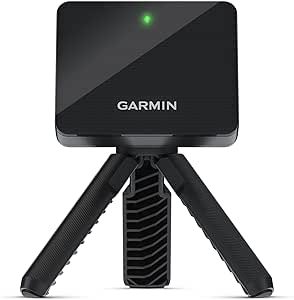
Garmin Approach R10, around $489.50†
7.8 oz with tripod · 10-hour battery · more than a dozen metrics
The R10 wins because it is small without being stripped down. Garmin lists the monitor at 5.2 ounces by itself and 7.8 ounces with the tripod. The included phone mount clips to a golf bag, so the entire range setup travels as one compact kit.
It tracks the numbers most golfers actually use: ball speed, club speed, launch angle, launch direction, carry, total distance, and estimated spin. Garmin Golf stores the session for you. Needing the app is the main inconvenience. The radar also needs space behind the ball, and spin is calculated rather than optically measured.
Those compromises matter less outdoors, where the R10 has room to see the ball fly. For a golfer who wants one monitor for the range, backyard net, and occasional simulator session, it is still the most balanced portable option.
2. Swing Caddie SC4: Best Without a Phone
The SC4 is the pick for golfers who do not want their phone involved in every bucket of balls. Its built-in display shows the result, and voice output can read the distance aloud. You can still connect the app when you want saved sessions or swing video, but ordinary range practice works without it.
That convenience comes in a larger body than the R10, and the base SC4 isn't as feature-rich as the newer SC4 Pro. The current Amazon price matters here: the original SC4 becomes especially attractive when discounted below its check current price list price. If it sits too close to the SC4 Pro at around $600, compare both before buying.
Check the current SC4 price on Amazon → · Read our SC4 and SC4 Pro breakdown →
3. Shot Scope LM1: Best Under $200
The LM1 is easy to understand: place it 4–5 feet behind the ball, choose the club, and read five numbers on the device: club speed, ball speed, smash factor, carry distance, and total distance. Shot Scope rates the battery for up to five hours, and the built-in display means an app is optional rather than mandatory.
It does not report launch angle, direction, or spin. That makes it a poor substitute for a fitting tool or simulator monitor, but a good range companion for gapping and speed work. At check current price, it avoids pretending to be more than it is.
Check the current LM1 price on Amazon → · Read the full LM1 review →
4. PRGR HS-130A: Fastest for Speed Training
PRGR is the monitor you can pull from a bag, switch on, and use almost immediately. There is no account, subscription, phone pairing, or tripod. It can also read a practice swing without a ball, which is why speed-training programs regularly pair well with it.
The limitation is the data set: club speed, ball speed, smash factor, and a carry estimate. It will not show launch, spin, or shot shape. Buy it for fast feedback during speed sessions, not because it is a miniature TrackMan.
Check the current PRGR price on Amazon → · Read the full PRGR review →
5. Rapsodo MLM2PRO: Best for Video and Measured Spin
The MLM2PRO combines radar with two cameras and includes its small tripod and carrying case. With RPT balls, it can report measured spin rate and spin axis while recording swing and impact video. That is more diagnostic information than the smaller range units provide.
It's portable, but it isn't frictionless. You need the tripod, a compatible phone or tablet, and marked balls for measured spin. The premium features also change the economics: Rapsodo currently lists a 45-day trial followed by about $200 per year, with two-year and lifetime options available. Golfers who only want carry numbers shouldn't pay for that ecosystem.
Check the current MLM2PRO price on Amazon → · Read the full MLM2PRO review →
6. FlightScope Mevo Gen2: Premium Portable Pick
Mevo Gen2 is the most capable travel-friendly monitor in this list. FlightScope specifies a 1.1-pound unit, up to six hours of battery, 20 base data parameters, and eight included E6 courses. Core data and firmware updates do not require an annual subscription.
It is better described as carry-case portable than pocket portable. For full swings, FlightScope recommends roughly eight feet from the unit to the ball; limited-flight use also needs about eight feet of ball flight and either metallic dots or Titleist RCT balls for accurate spin. The $1,299.00† price only makes sense if you will use its deeper data or simulator support.
Check the current Mevo Gen2 price on Amazon → · Read the full Mevo Gen2 review →
How We Ranked Portability
A small housing is only one part of portability. We weighted five practical questions:
- What else must travel? A phone, tripod, special balls, charger, or alignment accessories add bulk.
- How quickly can practice begin? A range tool should not require a miniature simulator installation.
- Can it finish the session? Manufacturer-rated battery life needs to cover a normal bucket with margin.
- Does it work outdoors? Every pick here is designed for range use, not only a controlled indoor bay.
- Is the data worth carrying? More metrics are useful only when they answer the golfer's actual practice question.
This is a research-and-analysis guide, not a claim that GolfLaunchLab physically tested every unit. Specifications and current terms were checked against Garmin, Voice Caddie, Shot Scope, Rapsodo, and FlightScope on July 23, 2026.
FAQ
Get Better Golf-Gear Research in Your Inbox
New comparison guides, product updates, and practical simulator-planning research. No daily deal spam. Free bonus: the golf distance cheat sheet, instantly.