Garmin R10 vs R50:
Is the Upgrade Worth $4,400?
Same brand, same app ecosystem, wildly different machines. We know the R10 inside and out from covering it since launch; here's exactly what the R50's cameras, built-in screen, and price tag change, and who should actually pay the difference.
Most golfers should buy the R10 and pocket the $4,400. It covers distance verification, practice data, and app-based simulation at a price that makes sense for a hobby. The R50 earns its premium in two specific cases: you practice mostly indoors (where its cameras directly measure what the R10's radar has to estimate), or you want a simulator without owning a PC, projector, or tablet: the R50's 10" touchscreen is the whole setup. Check R10 price → · Check R50 price →
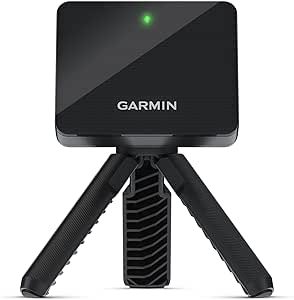
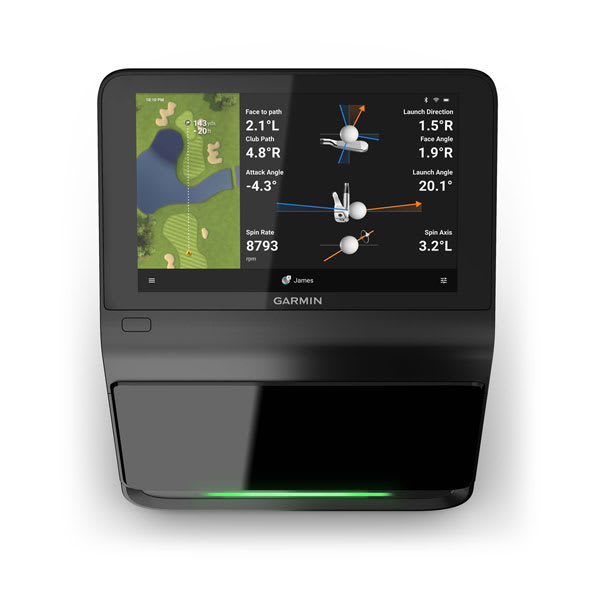
Manufacturer photos
Spec Comparison
| Approach R10 | Approach R50 | |
|---|---|---|
| Price | $489.50† | $4,999.99† |
| Technology | Doppler radar | Triple-camera optical |
| Spin rate / axis | Estimated | Directly measured |
| Club face data | Limited (radar-derived) | Camera-measured (face angle, path, attack) |
| Display | None: phone/tablet app | Built-in 10" touchscreen |
| Simulator | Home Tee Hero via app/PC | Home Tee Hero built in + 3rd-party compatible |
| Space behind ball | ~6 feet | None needed |
| Battery | ~10 hours | ~4 hours |
| Weight | 100g: pocket-sized | Tablet-sized unit |
| Membership | $99.99/yr (optional) | $99.99/yr (optional) |
Accuracy: Where the Gap Actually Shows
Outdoors with full ball flight, the R10 is genuinely good: owner reports and community comparisons consistently rate its ball speed and carry numbers reliable enough for distance gapping and practice. Its weakness is spin: radar at this price estimates it from flight characteristics, and indoors (where the ball flies 10 feet into a net) those estimates get wobbly. That's exactly the data the R50's three cameras photograph directly at impact, the same fundamental approach as the $3,778 Foresight GC3.
Practical translation: if your launch monitor lives at the driving range, the R10's accuracy is plenty. If it lives in your garage, the R50's camera data is a different class: particularly for wedge work and ball fitting, where spin is the whole story.
Simulator Experience
Both run Garmin's Home Tee Hero with 43,000+ real courses on the same $99.99/yr membership. The difference is everything around it. The R10 needs a phone propped on a stand (small), or a tablet/PC plus optionally a projector and screen (more money, more setup). The R50 is the screen: power on, hit balls, watch the hole render on the built-in display. It also outputs to third-party simulator software if you build a full bay later.
One honest R50 caveat from the spec sheet: ~4 hours of battery vs the R10's ~10. For all-day range sessions, the R10 actually travels better.
Which Is Better Value?
Think of it as cost-per-role. As a practice tool, the R10 at $489.50† is the best value in golf tech. That's been our position since we first covered it. As a complete simulator, the R50 at $4,999.99† competes against a SkyTrak+ ($2,995) plus a gaming PC, projector, and screen: a stack that easily passes $5,000 and still can't run untethered in the backyard. Against that build, the all-in-one is legitimately the simpler and often cheaper path.
Buy the R10 if: you want data and occasional app simulation, you practice outdoors, or $500 is the sane budget for your golf habit.
Buy the R50 if: you're building an indoor setup anyway, spin accuracy matters to your practice, and one-box simplicity is worth the premium.
FAQ
Get Better Golf-Gear Research in Your Inbox
New comparison guides, product updates, and practical simulator-planning research. No daily deal spam. Free bonus: the golf distance cheat sheet, instantly.