Garmin Approach R50 Review:
The All-in-One Has Arrived
A research-and-analysis review of the Garmin Approach R50: triple-camera measurement, the built-in 10-inch simulator that needs no PC, what the subscription really costs, and whether it's worth $4,400 more than the R10 we've covered extensively.
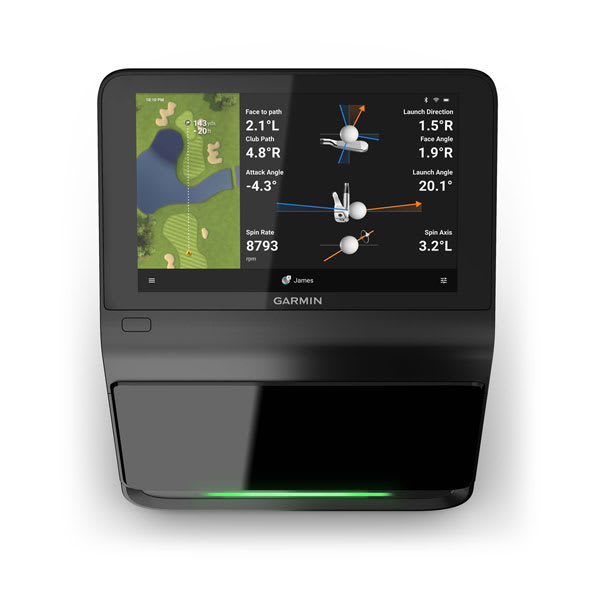
The Garmin Approach R50 is the first launch monitor that's genuinely all-in-one: three high-speed cameras, directly measured spin, and a built-in 10" touchscreen simulator that needs no phone, tablet, or PC. At $4,999.99† it sits between the SkyTrak+ and the Bushnell Launch Pro on price while making both look complicated to set up. The trade-offs: ~4 hours of battery, an optional $99.99/yr Garmin Golf membership for the full course library, and a price that's 8x the R10. Check the current price on Amazon →
Specs & What's in the Box
The R50 measures ball speed, launch angle, launch direction, spin rate and spin axis (directly measured), club head speed, face angle, club path, angle of attack, and more: 15+ metrics captured by three high-speed cameras rather than radar. Charging is USB-C, and the IPX3 rating means it shrugs off light rain at the range.
R50 vs R10: What $4,400 More Buys
| Approach R50 | Approach R10 | |
|---|---|---|
| Price | $4,999.99† | $489.50† |
| Technology | 3-camera optical | Doppler radar |
| Spin measurement | Directly measured | Estimated |
| Display | Built-in 10" touchscreen | None (phone/tablet app) |
| Simulator | Built-in: no PC needed | Via app/PC |
| Space behind ball | None (sits beside/ahead of hitting area) | ~6 feet |
| Battery | ~4 hours | ~10 hours |
| Membership | $99.99/yr (optional) | $99.99/yr (optional) |
Measured against the R10, the natural reference point, the R50's two upgrades that actually matter are directly measured spin, the R10's estimated spin is its weakest data point, especially indoors, and the built-in simulator. Every other launch monitor at any price needs a phone, tablet, PC, or projector to show you a virtual course. The R50 is the screen. For a garage or spare-room setup, that removes the most annoying (and often most expensive) part of the equation.
Accuracy: Why Cameras Beat Radar Indoors
Radar units like the R10 track the ball in flight, which is why they want 6+ feet behind the ball and open space ahead: indoors, short flight distances force them to extrapolate. Photometric (camera) units like the R50, SkyTrak+, and Foresight GC3 photograph the ball at impact, so they're at their best in exactly the cramped indoor spaces where radar struggles.
Garmin's triple-camera array directly measures spin rate and spin axis from ball markings: the same fundamental approach as the GC3 ($3,778 with no built-in sim) and Bushnell Launch Pro. Owner reports consistently describe ball-data accuracy in the same class as those units. Club-face data (face angle, path, attack angle) is also camera-measured, which at this price puts it in genuine fitting-tool territory.
The Built-in Simulator
The headline feature: Home Tee Hero runs on the device itself, on the 10" touchscreen, with 43,000+ real courses. No laptop, no projector, no app pairing: power it on and play. For golfers who found the "simulator" part of launch monitors intimidating (or who don't want a gaming PC in the garage), this is the entire pitch.
It also plays nicely with the bigger ecosystem: the R50 connects to third-party simulator platforms including GSPro and E6 Connect (GSPro's own documentation covers the R50, with a direct connection over the unit's built-in Wi-Fi hotspot as the recommended setup). So if you later build a full projector-and-screen bay, the R50 slots in as the engine rather than becoming redundant.
Garmin is also actively developing the platform rather than letting it sit: 2026 software updates (version 4.80 as of this writing) have added new play modes and a string of Home Tee Hero improvements since launch. For a $5,000 device, a manufacturer that keeps shipping features matters.
What the Subscription Really Costs
The full Home Tee Hero course library requires an active Garmin Golf membership: $9.99/month or $99.99/year, purchased through Garmin during setup. Core launch-monitor data and practice modes work without it. Over five years, that's ~$500 on top of the hardware: worth factoring in, but identical to what R10 owners pay for the same membership, and far below the $2,000+/yr software ecosystems on commercial units.
Garmin Approach R50 Price (2026)
As of 2026, the Garmin Approach R50 retails at $4,999.99†. Garmin gear discounts around major golf season moments and holidays, so confirm today's live price before buying.
Who Should (and Shouldn't) Buy It
Buy the R50 if: you want one box that's the launch monitor and the simulator, you practice indoors where camera accuracy shines, and the $5K bracket is genuinely your budget: against the GC3 at $3,778 plus a display, the R50 is arguably the value pick of the premium tier.
Skip it if: you mostly want range data and distance verification: the R10 at $489.50† covers that for an eighth of the price. Or if you already own a sim PC and projector, where the SkyTrak+ at check current price delivers comparable photometric ball data into the setup you have.
FAQ
Get Better Golf-Gear Research in Your Inbox
New comparison guides, product updates, and practical simulator-planning research. No daily deal spam. Free bonus: the golf distance cheat sheet, instantly.